








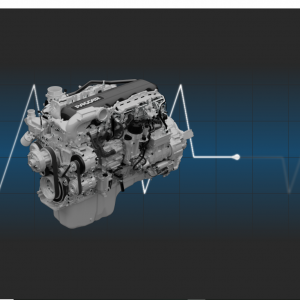
The Engine Oil Pressure Sensor is used to detect engine lubrication system failures. The sensor consists of a pressure sensitive diaphragm and amplifier. Engine oil pressure causes the sensor’s diaphragm to deflect and produce an electrical signal proportional to the pressure. The diaphragm deflection signal is amplified in the sensor. The sensor’s signal is monitored by the Engine Control Module (ECM). The engine control module (ECM) will set a diagnostic trouble code (DTC) and derate the engine to avoid engine damage if the sensor signal is not within predetermined limits, or the signal is not rational.
Conditions for diagnostic trouble code (DTC):
1) The voltage at pin EB:11 is less than 0.3?V
Observable symptoms
1) The engine oil pressure (EOP) gauge shows 0 when the engine is running
2) Loss of power
Probable cause
1) Open circuit, Signal wire
2) Open circuit, Supply wire
3) Short circuit to ground, Signal wire
4) Engine oil pressure (EOP) sensor
Related products
-
Volvo All Engines (2017 Emissions) Fault Code: P055A13 PID: EMS Engine Oil Pressure Sensor/Switch “B”
All Engines (2017 Emissions) -
Volvo All Engines (2017 Emissions) Fault Code: P054600 PID: ACM Exhaust Gas Temperature Open Circuit
All Engines (2017 Emissions) -
Volvo Engine D12D AE E3 (Tier 3) Fault Code: SID232 FMI 4 5 V Supply
D12D AE E3 (Tier 3) -
Volvo All Engines (2017 Emissions) Fault Code: P113B12 PID: EMS Turbo Compound Buffer Air Pressure Sensor
All Engines (2017 Emissions) -
Volvo All Engines (2013 Emissions) Fault Code: P009A00 PID: EMS Engine Air Intake Temperature – Correlation
All Engines (2013 Emissions) -
Detroit DD15 EPA10 (2010-13) Fault Code: SPN 709 FMI 4 (MCM, CPC) Short to Ground
DD15 EPA10 (2010-13)