

The Aftertreatment Hydrocarbon Dosing Module contains three non serviceable valves, the Aftertreatment Fuel Shutoff Valve, Aftertreatment Purge Air Valve and Aftertreatment Hydrocarbon Dosing Valve, and a serviceable Aftertreatment Fuel Pressure Sensor.
During DPF regeneration the Engine Control Module (ECM) sends a voltage signal to activate the Aftertreatment Fuel Shutoff Valve to the open position. This allows fuel to flow into the Aftertreament Hydrocarbon Dosing Module. The Aftertreatment Fuel Pressure Sensor monitors the fuel pressure value and sends a reference signal to the ECM. The ECM then sends a PWM signal to the Aftertreatment Hydrocarbon Dosing Valve that regulates the amount of fuel delivered to the Aftertreatment Hydrocarbon Doser through the air/fuel line.
Conditions for diagnostic trouble code (DTC):
1) Voltage above normal or shorted high
Diagnostic operating conditions
1) Ignition key in ON position
Observable symptoms
1) Regeneration not possible
2) Aftertreatment selective catalytic reduction (SCR) catalyst warming not possible
Probable cause
1) Connector
2) Short circuit to voltage supply, Control wire (+)
3) Engine wiring harness
4) Engine control module (ECM)
-
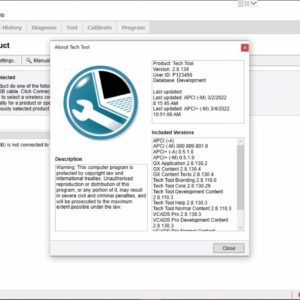
Volvo Premium Tech Tool PTT 2.8.130 Diagnostic Software 04.2022 ACPI ( 1 PC )
Trucks software $143.00
Related products
-
Allison 1000 & 2000 Gen 5 Fault Code:P2761 TCC PCS Control Circuit Open
1000 & 2000 Gen 5 -
Allison 1000 & 2000 Gen 5 Fault Code:P2764 TCC PCS Control Circuit Low
1000 & 2000 Gen 5 -
Allison 1000 & 2000 Gen 5 Fault Code:U0074 CAN Communications BUS 2 Off
1000 & 2000 Gen 5
-
Volvo All Engines (2010 Emissions) Fault Code: SPN 111 FMI 4 PID: Engine Coolant Level
All Engines (2010 Emissions) -
Volvo All Engines (2013 Emissions) Fault Code: P020613 PID: EMS Cylinder 6 Injector “A”
All Engines (2013 Emissions) -
Volvo All Engines (2017 Emissions) Fault Code: P204A11 PID: ACM Reductant Pressure Sensor
All Engines (2017 Emissions) -
Volvo All Engines (2017 Emissions) Fault Code: P030300 PID: EMS Cylinder 3 Misfire Detected
All Engines (2017 Emissions)